



One Clock, Twice the Value
Run corporate and sustainability strategy as one, and trust follows.
Business leaders,
Once a year, your organisation runs the single largest act of listening it will undertake. You consult stakeholders, interrogate risk, weigh what matters most to your future, and commit all of it to paper. The exercise is rigorous, expensive, and highly visible. And then, far too often, what it produces gets filed as compliance and never lived as strategy.
The trouble is not the report. It is that the obligation to produce one risks compliance becoming divorced from the development and articulation of strategy. A deadline that exists to publish has become the deadline to decide.
This pattern now has a name. Researchers call it ESG decoupling, and a 2025 review in Corporate Social Responsibility and Environmental Management warns that the rush to meet rigid disclosure deadlines is producing reporting fatigue without meaningful action, with strategy existing only on paper.1 The cause is structural.
A Timeline Problem, Not a Process Problem
Corporate strategy is forward-looking, set on a three to five year horizon in boardrooms and executive retreats, driven by capital allocation, market positioning and business growth. Sustainability strategy has been captured by an annual, backward-looking reporting cycle, driven by frameworks, audit readiness and risk.
The two operate on different clocks. By the time the sustainability team is triggered by the next reporting cycle to run materiality and set goals, the corporate budget for the year ahead is already locked.
This is not a failure of effort. It is a failure of sequence.
The Architectural Flaw
Insights surfaced inside the reporting window arrive too late to inform corporate strategy. Often it is already set, the capital already allocated Whatever the materiality assessments reveal can only be acted on later, if at all.
Running a materiality assessment, financial or sustainability, inside the reporting window is like writing the script after the film is shot.
And the Market Knows
Capital markets see through the disconnect. Research shows that where sustainability is built natively into corporate strategy, analysts respond positively. Where they detect a standalone sustainability strategy, developed independently and visible nowhere except in the report, they actively downgrade their perception of the company and issue fewer buy recommendations. The market reads strategic disconnection as weak governance, and prices it accordingly.2
This is no longer a soft argument about brand or culture. It is a hard one about valuation and the cost of capital. What analysts are really pricing is trust, their conviction that the strategy holds up under scrutiny and that capital is directed where value is genuinely created. Disconnection erodes that trust. Integration earns it.
Three Movements, in Their Proper Order
The remedy is a rearrangement. Think. Shape. Tell.
Think. Before the Cycle.
Decouple sustainability strategy from the reporting cycle. Recouple it to corporate strategy. Run materiality on a three to five year horizon, independent of the reporting deadline, and carry the findings into the corporate strategy conversation before capital allocation and budgets are set.
The question changes. Instead of asking what needs to be disclosed, leadership asks how market, regulatory and social shifts will affect the business model and its competitive positioning over the next decade.
This is not a longer or costlier exercise. It is the same listening, sequenced properly, with one decisive difference. The findings have somewhere to go. They land in the capital plan, the product roadmap, the M&A pipeline and the talent strategy. You stop running two strategies in parallel and start running one.
The same stakeholders and markets that judge your corporate strategy also judge your brand and your employer proposition. An integrated strategy makes room for bolder positioning, stronger talent attraction and enhanced reputation, because all three draw on the same foundation.
Shape. During the Season.
Once the thinking is done, the reporting season is transformed. It is no longer the moment you scramble to decide what you believe, but the moment you decide how to tell it, to everyone, not only to the regulator.
This is where storytelling comes into its own, and where the people who create reports do their finest work rather than their most pressured. The task shifts from assembling a compliance document to articulating one integrated strategy across every channel the business uses, of which the report is only one. Financial substance, brand promise and sustainability commitment finally read as one coherent account of the business, because they finally are one.
Tell. After the Report, and Everywhere.
A report is not a finish line. It is the starting gun for compelling communication and engagement.
Inside every serious report are stories worth telling, true ones earned through real work, that almost no one will ever read in their original home. The strategy it contains deserves a far wider life.
Look at the companies that have got this right. Unilever has hardwired sustainability into business unit P&Ls, so climate, nature and plastics targets sit on the desk of every Business Group President alongside commercial performance. Schneider Electric’s corporate strategy is its sustainability strategy, and its primary revenue engine. Neither tells that story only once a year. Neither needs to.
So tell it. Across every channel, internal and external, to people, talent, customers, investors and communities. Each needs a different proof point told in a different way. The integrated strategy is the source. The report is one of many channels through which it travels.
This is how a year of serious thinking earns its full return. Not as a document filed and forgotten, but as a story that shapes perception all year, builds reputation, strengthens brand equity, and earns the trust that compounds quietly into enterprise value.
The Ambition Activated Architecture
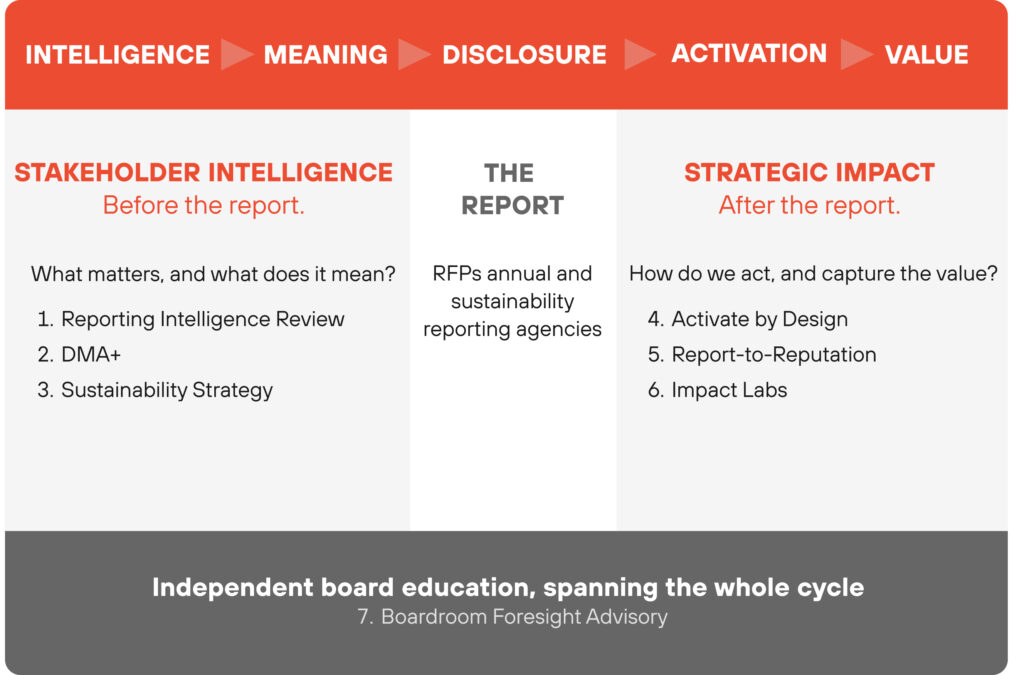
We have built our work around this thinking. It is an approach to integrated reporting grounded in integrated thinking, and we call it Ambition Activated. Three territories of activity, with the report sitting in the middle as one platform among many. Stakeholder Intelligence does the upstream work, before the report, turning data into the intelligence that shapes strategy. Strategic Impact does the downstream work, after it, carrying the strategy into behaviour, reputation and trust, through to the Impact Labs that turn ambition into action. Boardroom Foresight Advisory runs across the full cycle, helping boards understand the implications of sustainability for strategy, risk and long-term value, independently of the executives who brief them.
An integrated report is a publishing choice. An integrated strategy is a leadership choice. We are interested in the second. The report is simply one of the places it shows up.
The Choice in Front of You
KPMG’s 2025 Asia Pacific CEO Outlook found the gap stubbornly wide: 59% of the region’s CEOs say stakeholder expectations on sustainability now outrun their organisations’ ability to adapt strategy in response.3 The barrier is rarely intent. It is sequence.
So put strategy first. The work that matters is the integrated strategy itself, with corporate and sustainability finally on one clock, informing the same capital decisions and articulated through every channel the business uses. The report is one of those channels, important and worth crafting well. But it is not where the value is made. The value is in the integrated thinking the report contains, and in what that thinking earns once it is realised, a strategy every stakeholder connects with, proven by the stories that show it working.
Two strategies leak value. One realises it. And value realised, evidenced and told consistently, year after year, is how a company earns the one asset it cannot manufacture or buy, trust. Synchronise the clocks and you stop forfeiting half your value. Keep them synchronised and that value compounds into the trust that sustains the enterprise long after any single report is filed.
If you would like to explore what this could look like for your business, we would be glad to talk.
References
(1) Decoupling in Sustainability Reporting: A Systematic Literature Review (2025), Corporate Social Responsibility and Environmental Management.
(2) The Role of Sustainability Integration into the Corporate Strategy: A Perspective on Analysts’ Perceptions (2024).